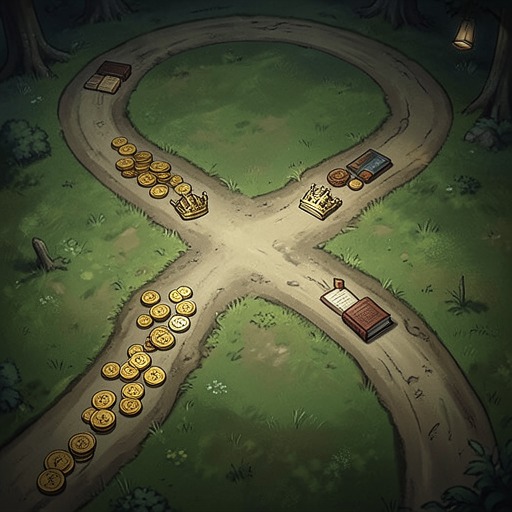
„Sík mezőben hármas út”
Csongor és Tünde“Sík mezőben hármas út” is a brief expression that makes a three-way road into an image of choice, divergence, and destination. Its defining contrast is between the paths that run off to either side and the middle way that reaches its goal. Later, the junction returns before Csongor as a magical circle, giving the image a more troubled force: a path may promise direction without resolving the uncertainty of what lies ahead.
Wording and Image
The expression opens with a level plain and a road dividing into three. The next lines set the two outer directions against the central one: the side roads run apart, while the middle road arrives at its destination. The image is economical but not neutral. It turns an ordinary junction into a choice whose alternatives are visibly unequal in outcome: divergence on the sides, arrival in the center.
The contrast does not explain what the destination is, or why the middle path reaches it. Instead, the image offers a simple spatial pattern that can carry a larger question. The road is legible, but the meaning of choosing among its branches remains open; direction and certainty are not the same thing.
First Appearance as Farewell and Guidance
In the earlier passage, Ilma speaks the lines and then wishes Csongor good luck before departing. The expression thus accompanies a leave-taking: it gives Csongor an image of the road ahead at the moment Ilma withdraws from the scene. Its parting wish makes the three-way choice sound like practical guidance, but the wording’s distinction between scattered side paths and the goal-reaching middle gives that guidance a proverbial shape.
That initial use also establishes the image as something Csongor can encounter again. The junction is not merely a feature of the landscape; it is a verbal pattern associated with the prospect of choosing a direction. Ilma’s farewell leaves that pattern in place without specifying which route Csongor should take or naming what his goal will be.
Return at the Three-Way Junction
The image returns in the second act, in a scene set in the region of the three-way road. Csongor calls it a crossroads of error, then recognizes the junction before him as standing like a magic circle. The change in emphasis is decisive: where the earlier expression arranged the routes into a clear contrast, Csongor’s description makes the same kind of junction feel strange and potentially misleading.
His language places desire and hope beside this sight. The road therefore becomes more than a choice among physical directions: it stands at the point where wishes and expectations meet the possibility of going astray. The magical-circle comparison intensifies the uncertainty without changing the basic geometry. The three routes still branch from one place, but now the junction appears to enclose or confront Csongor rather than simply point him onward.
Repetition and Significance
Across its two appearances, the expression moves from farewell counsel to an image of uncertainty. Ilma’s departing words set out an apparent rule—sideways routes scatter, the central one reaches the goal—while Csongor’s later response registers the junction as a crossroads of error and a magic circle. The recurrence preserves the original contrast but complicates its confidence: a visible middle route does not by itself settle the meaning of the choice.
The phrase’s force lies in that tension between a schematic promise and an unsettled experience. Its plain-road image supplies an intelligible pattern of alternatives and arrival; its later return connects that pattern with Csongor’s desire and hope, without naming a guaranteed destination. The three-way road can consequently function both as guidance offered at a parting and as a sign of the uncertainty that attends the search for a goal.